

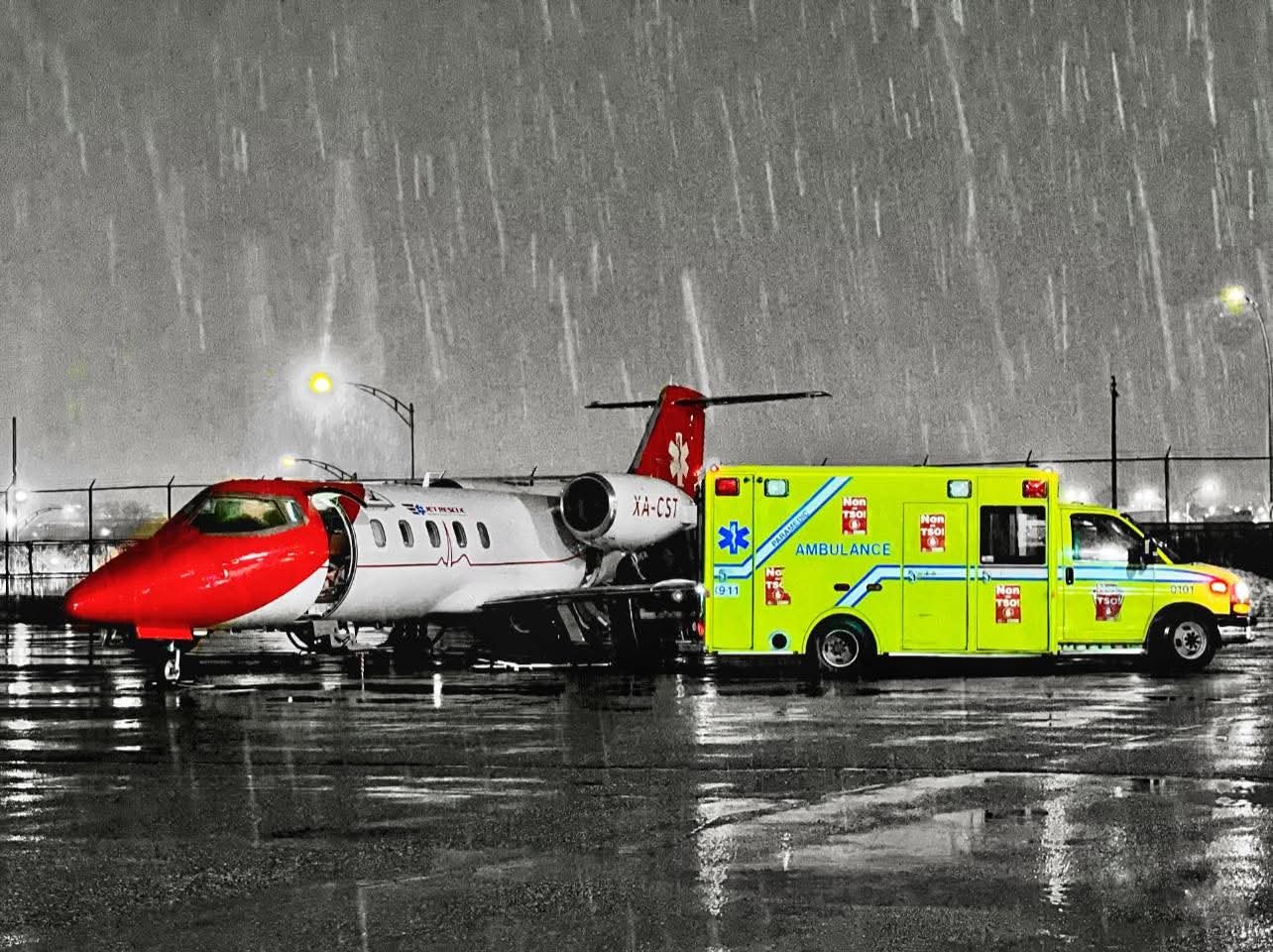
Air Ambulance Across South America
Air ambulance from South America: 2,000 to 3,800 nm legs, Andean high-altitude departures and the Amazon basin with no diversion fields.
South America Air Ambulance Service
South America is where the distances stop being a detail. Buenos Aires to Miami is 3,850 nautical miles, Lima to Miami 2,280, and a flight from the southern cone to North America is a nine-to-ten-hour operation with a technical stop, not an afternoon's work. A transport that would be routine from Central America becomes a long-range flight with crew duty limits, fuel planning and a different aircraft.
Altitude is the other half
The Andes impose a problem no other region in the Americas does. El Alto in La Paz sits at 13,300 feet, the highest international airport in the world; Cusco is at 10,900 feet and Bogotá at 8,400. High-elevation departures reduce how much weight an aircraft can lift from a given runway, which can mean less fuel, a shorter first leg or fewer people aboard. For the patient the problem runs the other way: someone already hypoxic at 11,000 feet is a different proposition from the same patient at sea level, and the ascent to cabin altitude has to be planned around that.
The Amazon basin
Across much of the interior there is no suitable diversion field for hours at a time. A flight from Manaus, Iquitos or the Bolivian lowlands is planned with that in mind: oxygen and consumables for the whole leg with reserve, and a route chosen for the fields that exist rather than the shortest line.
Where the hospitals are
Buenos Aires, São Paulo, Santiago, Bogotá and Lima all have strong tertiary hospitals, so a patient in a capital city rarely needs to leave for capability reasons. The transports that change outcomes are the ones out of the interior into those capitals, and the repatriations home for patients whose treatment is finished or whose insurer requires it.

What is arranged
Jet Rescue arranges the long-range ICU aircraft, the flight physician and critical care paramedic, the technical stops and permits, and the ground legs and hospital acceptance at both ends.
Tell us about the patient
A mission coordinator answers 24 hours a day. The benefits review is free and carries no obligation.