

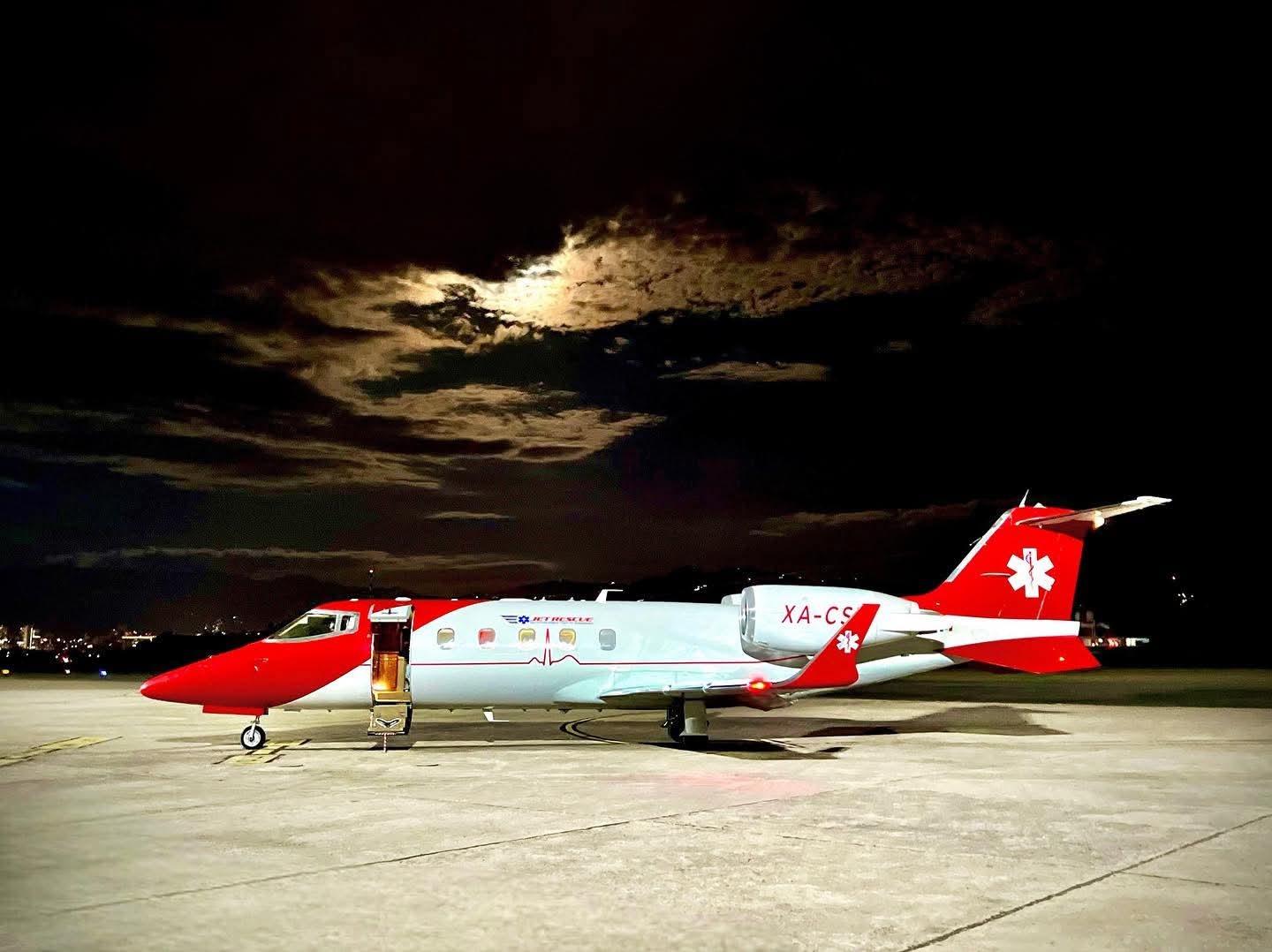
Air Ambulance From Central America to the United States
Air ambulance from Guatemala, Honduras, Costa Rica, Panama and Belize to US hospitals. Free with qualifying insurance, fixed all-inclusive price self-pay.
Critical care repatriation from Guatemala, Honduras, El Salvador, Nicaragua, Costa Rica, Panama and Belize to US hospitals.
A region we fly every week
Central America to the United States is one of our highest-volume corridors, in both directions: US citizens taken ill while travelling or living in the region, and Central American nationals being repatriated home from US hospitals. We hold the ground ambulance and receiving hospital relationships at the Latin American end directly rather than brokering them, which is what makes a same-day confirmation possible.
Where we fly from
Guatemala City, San Pedro Sula, Tegucigalpa, Roatan, San Salvador, Managua, San Jose, Liberia, Panama City and Belize City, plus the smaller fields that serve the resort and expatriate areas. Receiving hospitals are typically in Miami, Houston or Dallas, selected by clinical need and by proximity.

What makes this corridor technical
Several of the region's principal airports sit at altitude or are surrounded by terrain, and a number of the secondary fields have no night operations and no instrument approach. That affects which aircraft can be used, what the fuel load can be, and whether a patient can move today or has to wait for first light. We plan the route and the aircraft around the patient rather than quoting a flight and discovering the constraint afterwards.
Cabin altitude matters for some patients more than others. A patient with a severe head injury, a pneumothorax, significant anaemia or decompression illness is affected by cabin pressurisation in ways that change the flight profile. Our medical crews brief that with the treating physician before departure.
Roatan, Ambergris Caye and the dive and resort destinations
Diving injuries, road traffic trauma and cardiac events in the resort areas are a regular part of this corridor. Where a patient needs a hyperbaric chamber we will route to the nearest functioning chamber rather than the nearest big city, and where they need a US trauma centre we fly them straight there.
How the flight is paid for
Most Central American transports are paid either by a travel insurer or by the family directly, and the two move at different speeds. An insurer-funded flight waits on a medical review and an authorisation; a self-pay flight waits only on the receiving bed. For self-pay we quote one fixed price in writing, with nothing added afterwards.
Two regional details catch families out. Private hospitals in the region generally expect payment or a deposit on admission, independent of whatever the transport costs. And expatriate residents in Panama, Costa Rica and Belize frequently hold a local health plan that covers treatment in-country but nothing that crosses a border, which is worth reading before it is needed rather than during.
We verify benefits at no charge, document medical necessity with the treating physician, and obtain the authorisation before the aircraft is released. See our air ambulance insurance page for what different plans cover and the cost page for what sets the price.
Where we fly
Each of these corridors has its own aircraft requirements, permit timelines and insurance pattern. The pages below set out what actually applies on each one.
Air ambulance Caribbean to the United States
Air ambulance South America to the United States
Air ambulance Hawaii to the mainland United States
Air ambulance Canada and the United States, both directions
Air ambulance Asia to the United States
Air ambulance Europe to the United States and Canada
Licensing and authority
MED JETS S.A. de C.V., doing business as Jet Rescue, operates its air ambulance fleet under Mexico AOC MTS/2015. Med Jets USA, Inc. holds Florida Department of Health EMS Service Provider licence AIR9505, status clear, verifiable on the State of Florida public licence register. Med Jets USA, Inc. is an indirect air carrier authorized under U.S. Department of Transportation Order 83-1-36, 99 C.A.B. 801 (1983), and does not operate any aircraft. All flights are operated by licensed FAA Part 135 direct air carriers or foreign equivalent carriers.
Speak to a mission coordinator
You will reach a mission coordinator, not a call centre. Send the insurance card front and back, the patient name and date of birth, the hospital they are in, and a short description of the medical situation. The benefits review is free and carries no obligation.
Patient Focused
Tell us about the patient
A mission coordinator answers 24 hours a day. The benefits review is free and carries no obligation.