

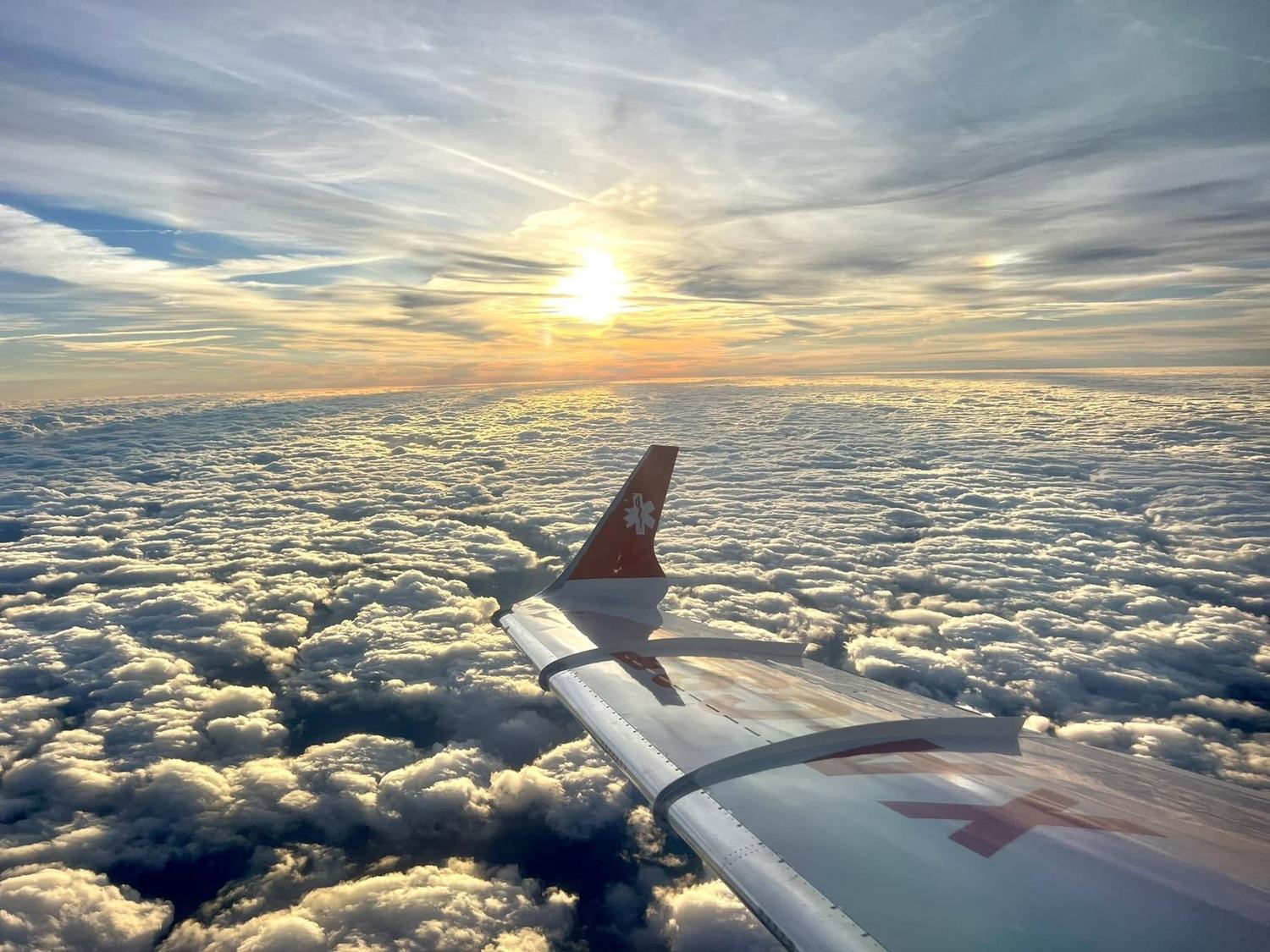
Aeromedical transport
Why altitude changes a patient's physiology, what a pressurised cabin does not fix, and how we plan a flight around the patient.
A cabin is not a hospital room at altitude
Aeromedical transport is the clinical discipline of moving a patient by air. It is a separate body of knowledge from ground critical care, because altitude changes the patient in ways that a hospital bed never does.
What pressurisation actually gives you
A business jet cruising at 41,000 feet typically holds a cabin altitude around 6,000 to 8,000 feet. That is not sea level. It is a mountain. Two consequences follow, and both are clinically real.
Less available oxygen
At a cabin altitude of 8,000 feet, the partial pressure of oxygen is roughly three quarters of what it is at sea level. A healthy passenger compensates without noticing. A patient with respiratory failure, severe anaemia, a recent myocardial infarction or raised intracranial pressure may not. The margin that looked adequate on the ward can disappear in the climb.
Gas expands
Boyle's law is not a theoretical concern in an aircraft. Any trapped gas expands by roughly a third between sea level and an 8,000-foot cabin. That matters for a pneumothorax, for bowel gas after abdominal surgery, for intracranial air, for a tracheal tube cuff, and for anything else sealed inside the patient. A cuff inflated with air on the ground is over-inflated at altitude unless someone manages it.
Flying at a lower cabin altitude
When the patient cannot tolerate 8,000 feet, the aircraft can be flown lower, or flown high with a restricted cabin altitude. It costs fuel and therefore range, and on a long sector it can mean an extra stop. That is a clinical decision with an operational price, and it should be made by the physician planning the flight, before departure, not discovered in the climb.
The other things that change
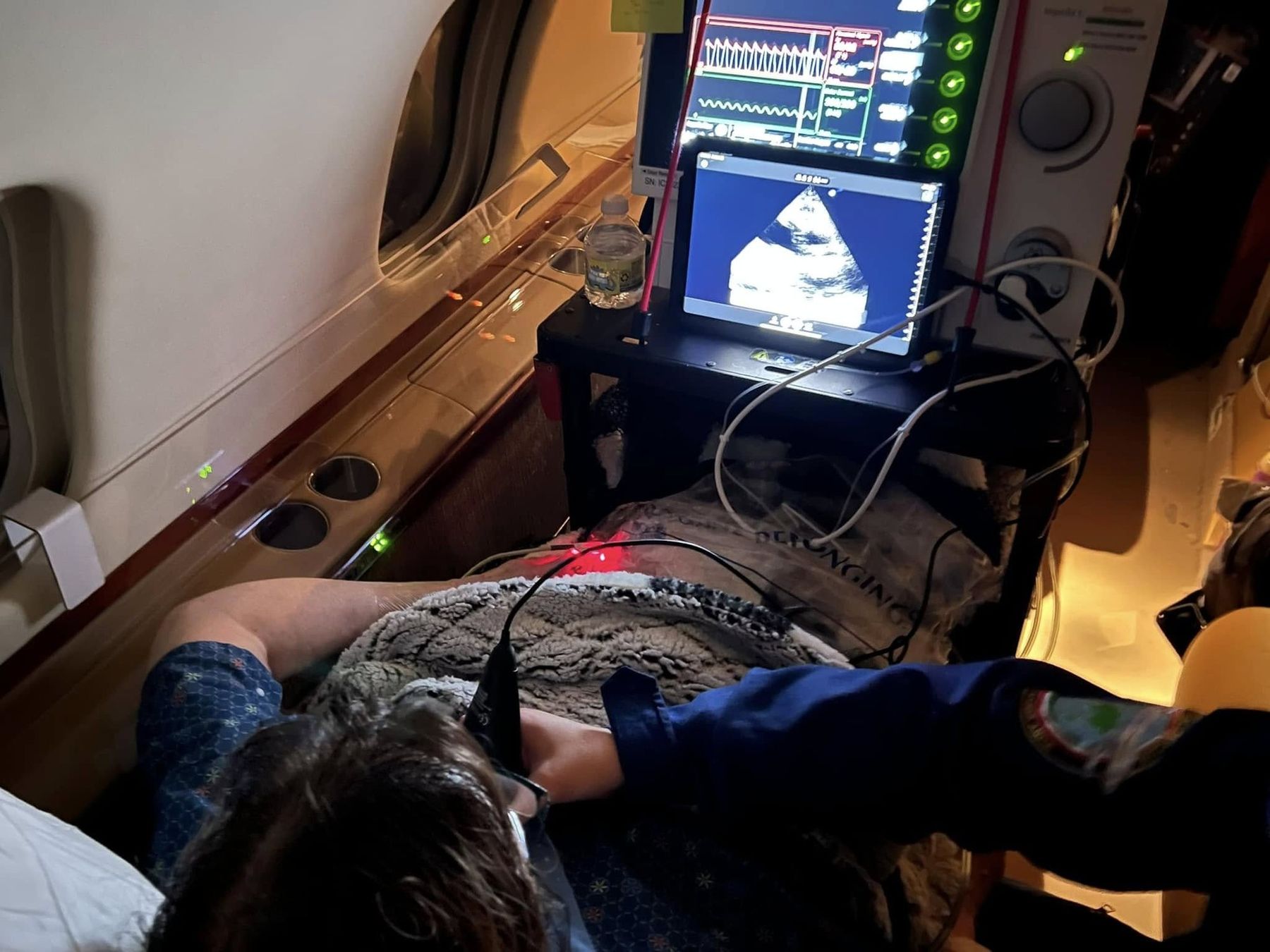
- Noise and vibration. A Learjet cabin is loud. Auscultation is close to useless in the cruise, which is why monitoring, capnography and ultrasound matter more in the air than a stethoscope does.
- Access. The patient is reachable from one side only. Anything that might be needed urgently is positioned before the door closes.
- Humidity. Cabin air is very dry, which affects secretions and fluid balance over a long sector.
- Acceleration. Climb and descent shift fluid along the length of the patient. Stretcher orientation is a clinical choice, not a loading convenience.
- Temperature. Hard to control precisely, and it matters most for the patients least able to regulate it — neonates above all.
Why we train in an aircraft
Jet Rescue converted a Learjet airframe into a dedicated medical simulator, the only one of its kind in Latin America, and our medical crews train inside it. A conference room does not teach you to manage a deteriorating patient in a cabin you cannot stand up in, reaching from one side, with the equipment where you left it rather than where you want it.
The Learjet simulator · What we carry · The medical crew · Choosing the right modality
Tell us about the patient
A mission coordinator answers 24 hours a day. The benefits review is free and carries no obligation.