

Air Ambulance Fleet — Advanced ICU-Equipped Medical Jets
Jet Rescue Air owns and operates the largest fleet of Dedicated Medical Air Ambulance Learjets in Mexico and South America. Call Us: +17866191268
What we fly, and why it matters to you
We own and operate our aircraft. When you call us you are talking to the company that will actually fly your relative — not a broker who will go looking for an aircraft after you hang up. The fleet is ten medically equipped jets, one helicopter based in Mexico City, and two ground ambulances of our own.
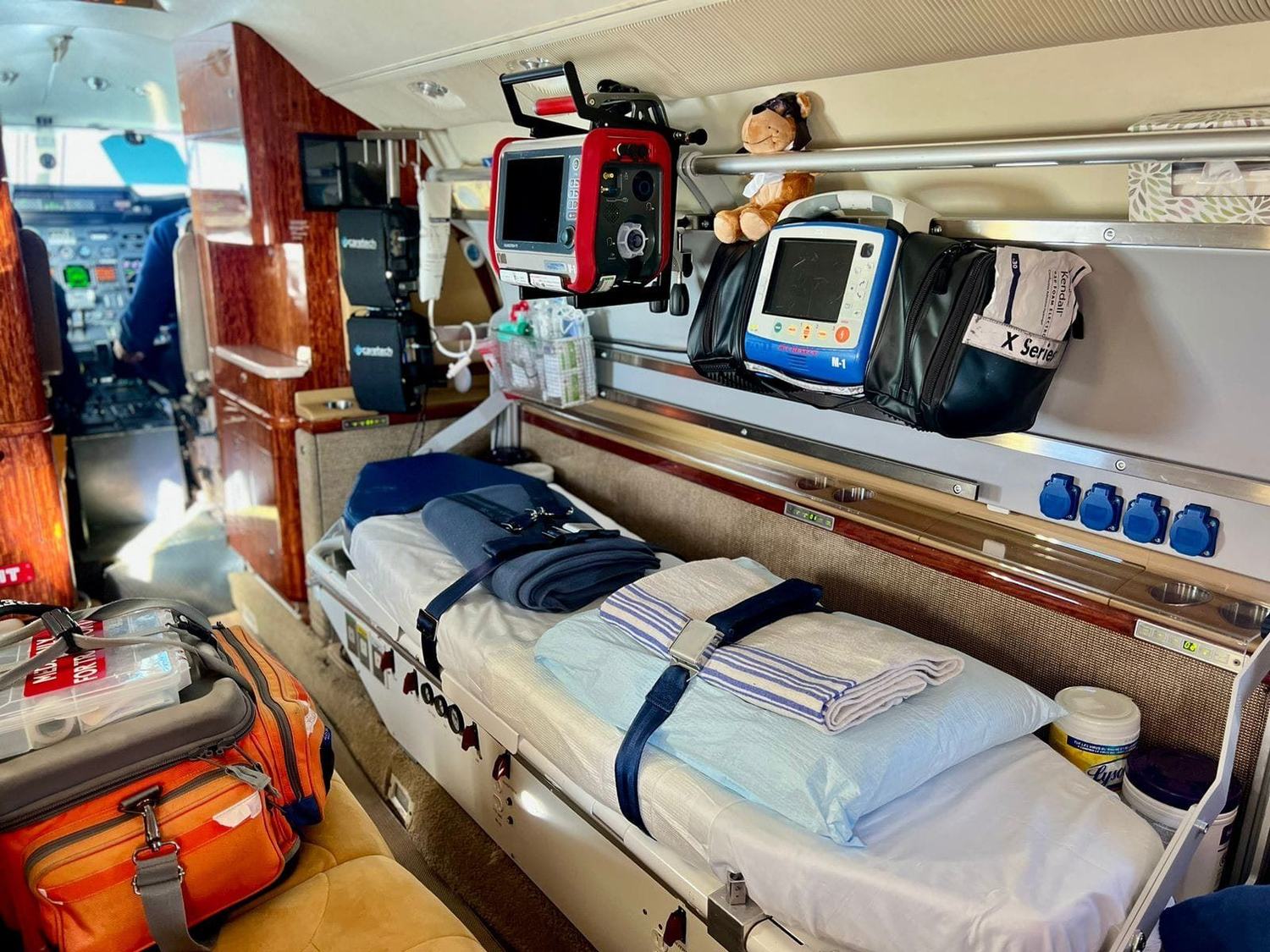
Every one of the jets is fitted out the same way: a LifePort stretcher that bolts to the airframe, oxygen for the whole flight with reserve on top, mains-style power at the stretcher so the ventilator, pumps and monitor never run on battery alone, and suction. A doctor and a flight paramedic fly with the patient. Two airline-rated pilots fly the aircraft. Any of the jets can carry two patients on two stretchers when a case calls for it.
The difference between the aircraft is not the standard of care. It is how far they go without stopping, and how much room there is around the patient.
Learjet 35-ARX — the workhorse
This is the aircraft most missions fly on. It covers about 2,900 nautical miles without refuelling, which from our Mexican bases reaches anywhere in North America, the Caribbean and the northern half of South America in one leg. It cruises at around 530 mph and flies at 45,000 feet, above most of the weather.
Two of ours carry the Avcon R/X modification, which adds fuel at the wingtips and buys extra range on a long case.
Learjet 36-ARX — the long-range pair
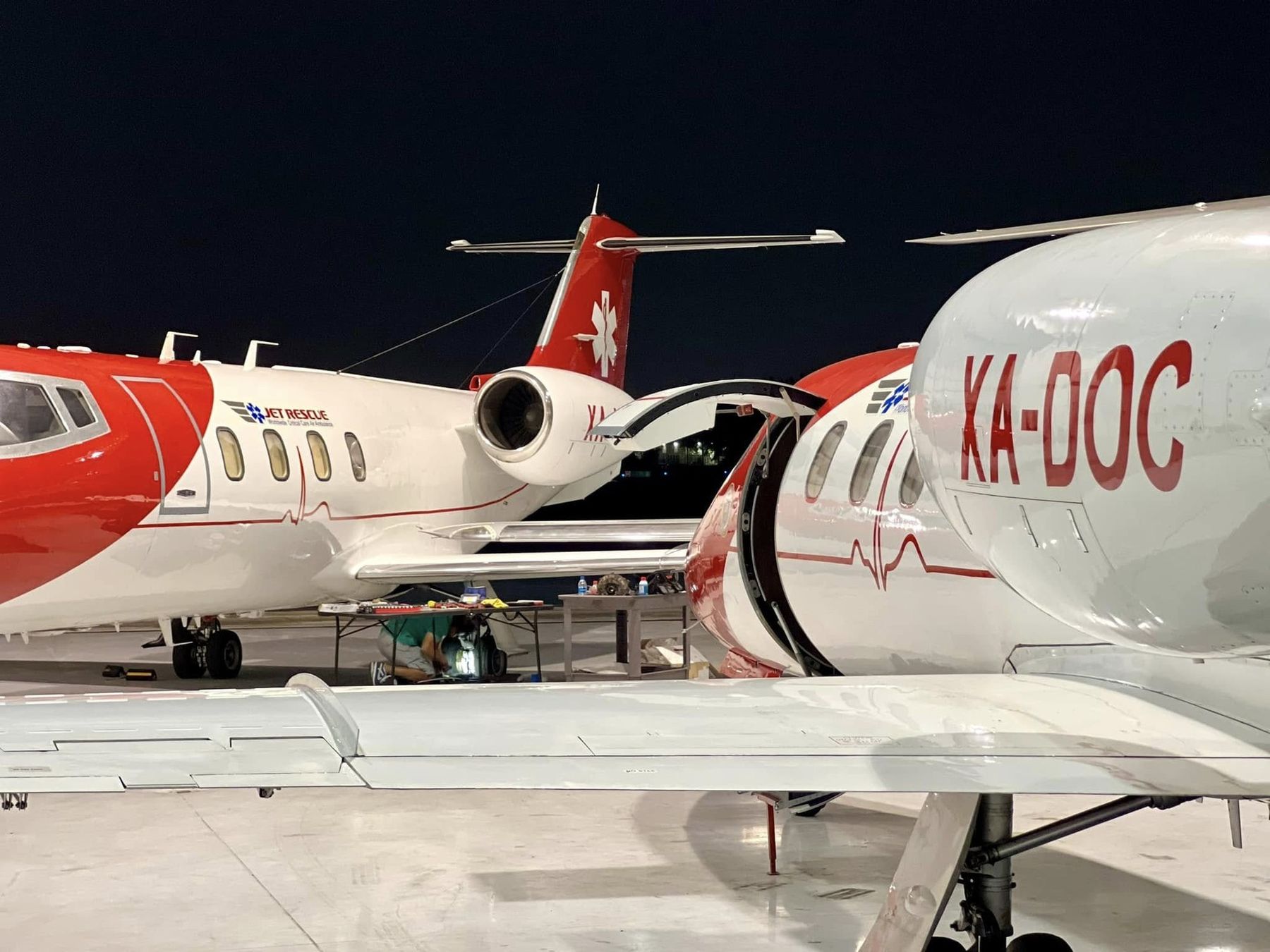
We have two of these, and they are the ones we reach for when the distance is the problem. A standard Learjet 36 carries about 2,425 to 2,550 nautical miles. Ours are modified with the Avcon R/X package, which adds roughly 750 pounds of usable fuel in each wingtip tank and takes them past 2,800 nautical miles — up to forty minutes more flying at normal cruise.
Forty minutes does not sound like much until it is the difference between one fuel stop and two, or between a flight your insurer will approve and one they will not. On a long transoceanic or transcontinental case, those extra miles are often what makes the mission possible at all. XA-DOC is one of the two.
Learjet 60 — the one with room to work
XA-CST is our Learjet 60. It goes about 2,500 nautical miles, cruises at 530 mph and flies as high as 51,000 feet, but the reason we use it is the cabin: nearly twice the volume of a Learjet 35. On a patient who needs a lot of equipment and a lot of hands — ECMO, a balloon pump, an Impella, a ventilated patient on multiple infusions — the crew can actually stand up and move around the stretcher instead of working folded over it. There is also more seating, so a relative can travel without being in the crew's way.
Which one will fly my relative?
You do not have to decide. Tell our coordinator where the patient is, where they need to go, and what the treating doctor says about their condition. We match the aircraft to the distance and to how much equipment and crew the patient needs, and we tell you which one is coming and when it will be there. If a shorter, cheaper aircraft will do the job safely, that is the one we send.

XA-CST on the ramp
XA-CST, the Learjet 60, taxiing at the Jet Rescue base.
Tell us about the patient
A mission coordinator answers 24 hours a day. The benefits review is free and carries no obligation.