

Top Onboard Air Ambulance Equipment Explained
Top onboard air ambulance equipment supports critical care at altitude. Learn what must be available for safe, coordinated medical transport worldwide.
A medical flight is not simply a hospital transfer with wings. The top onboard air ambulance equipment must sustain intensive care when the patient is thousands of feet above the ground, far from a bedside team, pharmacy, imaging department, or backup unit. For families, hospitals, and case managers, the right question is not whether an aircraft has medical equipment. It is whether the aircraft, clinical crew, and mission plan can support this specific patient from departure through handoff.
Aircraft configuration should always follow the patient’s diagnosis, stability, anticipated complications, weight and mobility needs, and the distance to the receiving facility. A patient requiring oxygen during a short transfer does not need the same setup as a ventilated trauma patient, a neonate in an isolette, or a patient supported by ECMO. This distinction drives safe transport planning.
What Top Onboard Air Ambulance Equipment Must Do
Medical equipment in an air ambulance operates under different conditions than equipment in a hospital room. Aircraft vibration, altitude, noise, limited cabin space, power management, weather, and changing cabin pressure can all affect patient care. Equipment must be secured, portable, compatible with the aircraft’s electrical systems, and supported by sufficient batteries, oxygen, medications, and clinical redundancy.
The best-equipped aircraft also are not necessarily those carrying the most devices. Capability depends on an integrated system: appropriately maintained equipment, qualified clinicians trained to use it in flight, protocols for equipment failure, and direct coordination with sending and receiving physicians. For high-acuity missions, the team must be prepared to respond immediately if the patient’s condition changes.
Advanced monitoring for changing conditions
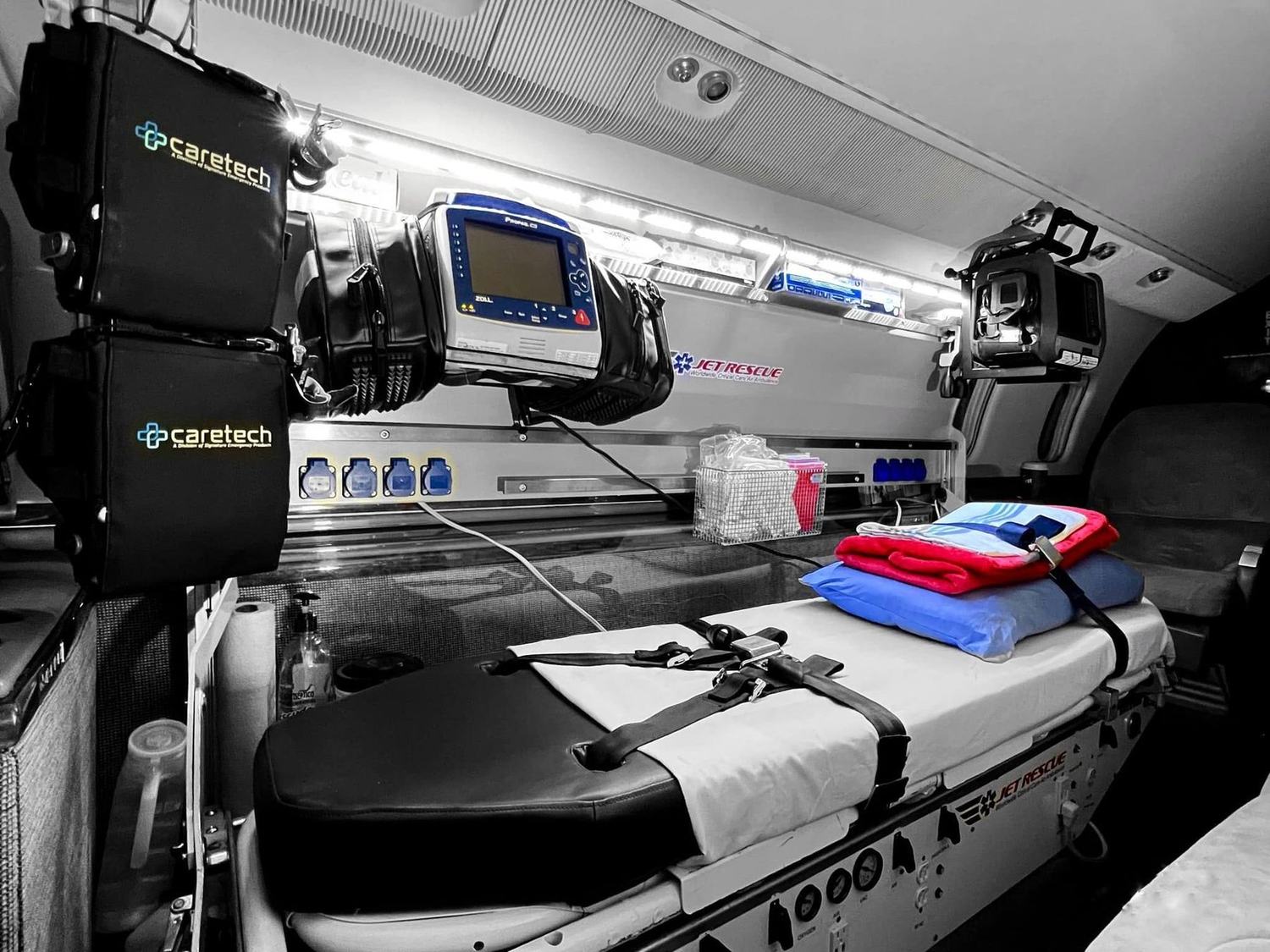
Continuous monitoring provides the clinical team with the information needed to recognize deterioration early. Depending on the patient’s condition, onboard monitoring may include ECG rhythm monitoring, noninvasive and invasive blood pressure monitoring, pulse oximetry, end-tidal carbon dioxide monitoring, respiratory rate, and temperature measurement.
A transport-grade monitor-defibrillator is particularly important for critical care missions. It allows the team to track cardiac activity, identify unstable rhythms, provide synchronized cardioversion when clinically indicated, and deliver defibrillation during a cardiac emergency. For patients on vasoactive medications, invasive pressure monitoring can provide more precise information than intermittent cuff readings.
The value is not the screen itself. It is the ability of a critical care team to interpret trends, act on changes, and communicate meaningful clinical updates to the receiving facility before landing.
Ventilators and airway management systems
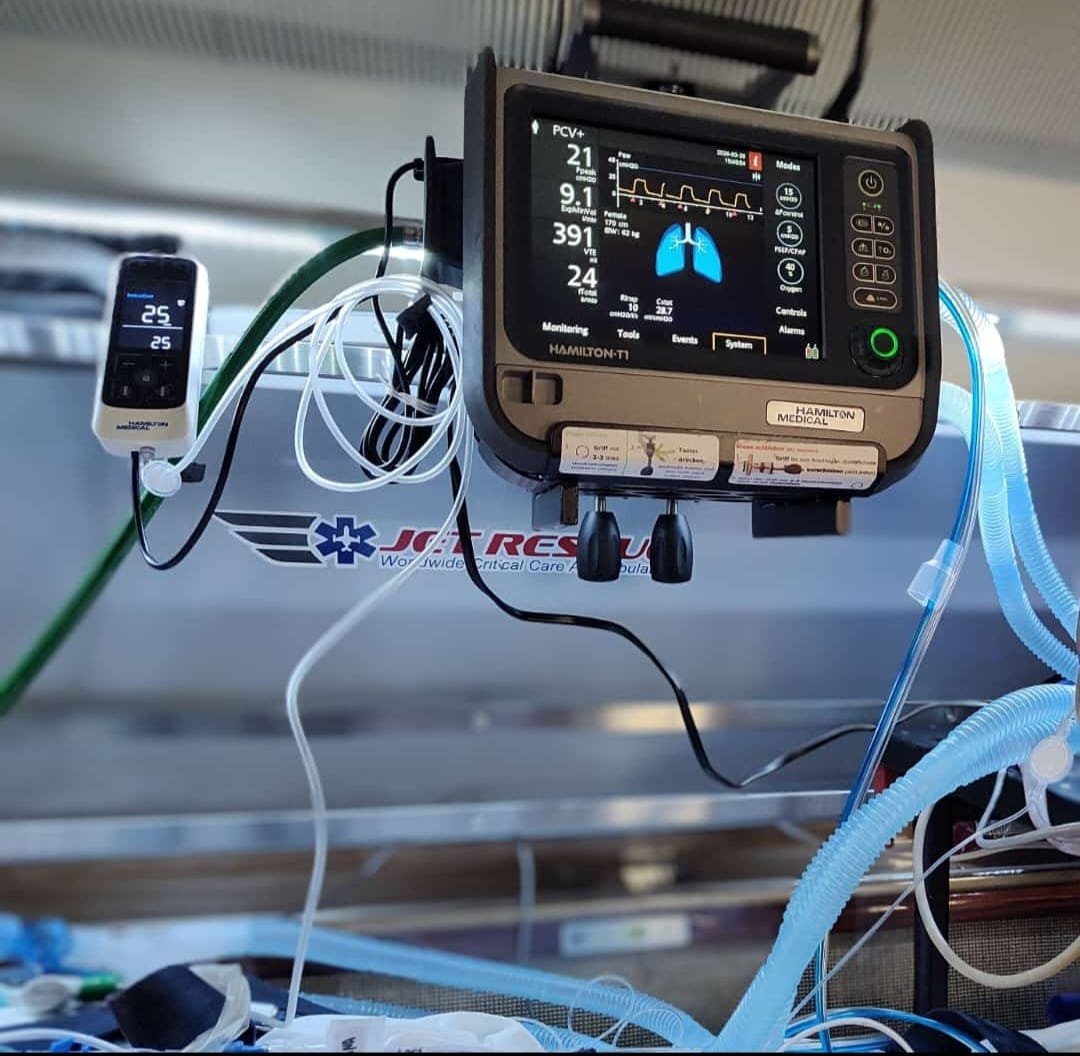
For intubated patients or those with significant respiratory failure, a flight-capable transport ventilator is central to the mission. These units are designed to deliver controlled ventilation in the aircraft environment and may support a range of modes based on the patient’s needs. The team must also carry airway supplies for planned or emergency intervention, including suction, laryngoscopy equipment, endotracheal tubes, rescue airway devices, and manual ventilation capability.
Ventilator selection and settings require careful planning. Altitude and cabin-pressure changes can affect gas volumes, while a long-range mission may require reliable battery endurance and multiple backup power options. Patients with severe lung injury, pulmonary hypertension, or complex ventilator requirements may need a more specialized critical care configuration than a stable patient traveling with supplemental oxygen.
Oxygen systems that match the mission length
Oxygen is one of the most essential and most carefully calculated resources onboard. It supports patients receiving low-flow oxygen, high-flow delivery, noninvasive ventilation, invasive ventilation, and certain neonatal or critical care therapies. A medical transport team must calculate anticipated consumption before departure, then build in reserves for delays, diversions, and unexpected clinical changes.
The aircraft’s oxygen system should not be viewed as a single tank. Safe planning considers flow rate, device settings, duration, backup cylinders, transfer time on the ground, and the possibility of holding patterns or alternate airports. For a patient whose respiratory support is escalating, oxygen planning becomes a primary operational and clinical concern.
Medication delivery and infusion pumps
Critical patients often travel with continuous medications that cannot be interrupted. Transport infusion pumps allow the crew to administer vasopressors, sedatives, analgesics, antiarrhythmics, insulin, anticoagulants, antibiotics, fluids, and other therapies according to the patient’s treatment plan.
These pumps must be secure and accurate in flight, with enough channels to manage multiple infusions when necessary. Battery capacity matters, as does the availability of compatible syringes, tubing, labeled medications, and backup supplies. Before departure, the team should reconcile every infusion, verify concentrations and rates, and determine which medications must continue without interruption.
A well-stocked medication system also includes emergency drugs appropriate to the mission profile. The exact formulary varies, but the principle remains consistent: medications should match foreseeable complications and be managed by clinicians authorized and prepared to use them.
Equipment for Specialized Air Ambulance Missions
Some patients require a standard critical care setup. Others need a dedicated clinical platform with highly specialized equipment and personnel. These missions demand earlier coordination because not every aircraft or crew configuration is suitable.
Neonatal and pediatric transport equipment
Newborns and children cannot be treated as smaller adults. Neonatal air ambulance missions may require a transport isolette that provides thermal regulation, secure positioning, integrated monitoring, oxygen delivery, and space for pumps and ventilator support. Weight-based medication dosing, pediatric airway equipment, and age-specific monitoring accessories are equally essential.
For neonatal intensive care transfers, the care team may include clinicians with advanced neonatal transport experience. The cabin configuration must accommodate the isolette safely while preserving access to the patient throughout the flight. Premature infants and critically ill newborns can be especially sensitive to temperature changes, respiratory instability, and vibration, making specialized preparation essential.
ECMO transport capability
ECMO transport represents one of the highest-acuity forms of air medical transfer. Extracorporeal membrane oxygenation can provide advanced cardiac and respiratory support for selected patients with severe failure of the heart or lungs. Moving a patient on ECMO requires more than placing the circuit onboard.
The mission may require an ECMO console, oxygen supply for the circuit, specialized pumps, blood-management supplies, emergency clamps and backup components, and a team experienced in managing both the patient and the extracorporeal system. Weight, electrical load, cabin access, and contingency planning are major considerations. ECMO transport should be coordinated closely with the referring and receiving ECMO centers, with every handoff planned in detail.
Obstetric and trauma readiness
High-risk obstetric transports require equipment and medications that support both maternal and fetal concerns. Depending on the case, this can include fetal assessment capability, hemorrhage preparedness, blood-product coordination, magnesium sulfate infusion management, and emergency delivery planning. Not every obstetric patient needs an air ambulance, but when transfer is medically necessary, timing and the receiving facility’s capabilities are decisive.
Trauma missions may require spinal-motion restriction tools, hemorrhage-control supplies, splinting, wound-care materials, rapid fluid and blood-product administration capability, and strong communication with trauma centers. The transport team must understand whether the patient is stable enough for flight or needs stabilization before departure. Fast transport never replaces sound clinical judgment.
The Equipment Outside the Aircraft Matters Too
Onboard capability begins before takeoff and continues after landing. Ground ambulances, ramp transfers, stretcher loading systems, portable oxygen, and communication between teams are part of the same chain of care. A patient can be clinically stable in the aircraft but vulnerable during transitions if equipment, staffing, or timing are not coordinated.
For international medical evacuation, operational planning adds further complexity. Medication documentation, customs requirements, airport permissions, ground transport at both ends, receiving-bed confirmation, and language coordination can affect timing. The medical crew needs a complete clinical report, while the operations team needs a route that supports the patient’s medical and logistical requirements.
Jet Rescue Air coordinates advanced air medical transport with mission-specific equipment and clinical staffing, including critical care, neonatal, pediatric, obstetric, and ECMO-level transport needs. The appropriate configuration is determined case by case, based on the patient rather than a one-size-fits-all equipment list.
Questions to Ask Before Approving a Flight
When arranging a medically supervised flight, families and referring professionals should ask what level of care is planned, who will staff the mission, and whether the team has experience with the patient’s diagnosis and current therapies. Ask how oxygen duration, power needs, medications, and backup equipment will be managed for the full journey, including ground transfers.
It is also reasonable to confirm the aircraft’s medical configuration, the communication plan with the sending and receiving teams, and the process if the patient deteriorates or weather changes the route. For complex cases, the strongest answer is often specific rather than broad. A provider should be able to explain how the mission will support the actual patient in front of them.
The right equipment creates capability, but preparation turns that capability into care. When a patient needs urgent transfer, the safest flight is the one planned around the patient’s condition, with the clinical team, aircraft resources, and destination working as one coordinated system.
Tell us about the patient
A mission coordinator answers 24 hours a day. The benefits review is free and carries no obligation.