


Neurocritical Patient Transport Safety Requirements
Neurocritical patient transport requires ICU-level planning, monitoring, and coordination to move unstable neurologic patients safely between facilities.
A patient with a severe brain injury, stroke, intracranial hemorrhage, or uncontrolled seizures cannot be treated like a routine transfer. Neurocritical patient transport is an extension of ICU care, performed in a moving clinical environment where a small change in oxygenation, blood pressure, ventilation, or head position can affect neurologic outcome.
For families, hospital teams, and case managers, the question is not simply whether a patient can be moved. It is whether the transport plan can maintain the physiologic targets established by the sending and receiving clinicians from departure through handoff. That requires the right aircraft or ground platform, the right critical care team, and disciplined coordination before the patient leaves the bedside.
Why neurologic transfers demand a higher standard
Neurocritical patients often have limited physiologic reserve. A patient may appear stable while supported by a ventilator, vasoactive medications, sedation, an external ventricular drain, or continuous seizure monitoring. Removing that patient from the ICU introduces predictable stress points: transitions between equipment, movement during loading, vibration, noise, altitude changes, and reduced access to hospital resources.
The transport objective is to prevent secondary brain injury. Depending on the diagnosis, this may mean avoiding low oxygen levels, elevated carbon dioxide, hypotension, fever, low blood sugar, seizures, or elevations in intracranial pressure. These are not generic transport concerns. They are specific clinical targets that must be understood by the transport team before the mission begins.
A stable patient recovering from an uncomplicated stroke may be appropriate for a scheduled medical flight with basic monitoring and a medical escort. A patient with a recent craniotomy, active vasospressor infusion, severe traumatic brain injury, or ongoing status epilepticus may require a fixed-wing critical care air ambulance staffed and equipped for ICU-level intervention. The correct level of care depends on the patient’s current needs, not only the diagnosis listed in the chart.
Building a neurocritical patient transport plan
A safe transfer begins with a physician-to-physician clinical discussion and a detailed review of the patient’s current condition. The sending facility, receiving facility, and transport coordinator should agree on the reason for transfer, the urgency, the destination bed availability, and the care requirements during flight.
Define the clinical priorities before departure
The transport team needs more than a discharge summary. It needs current information: neurologic examination trends, airway status, ventilator settings, blood gas results when relevant, medication infusions, imaging findings, procedures performed, laboratory values, and the plan if the patient deteriorates.
For many patients, the clinical team will establish parameters for blood pressure, oxygen saturation, end-tidal carbon dioxide, temperature, glucose, and sedation. If intracranial pressure is a concern, the plan should address head elevation, neck alignment, drainage-device management, and the medications available for an acute rise in pressure. The team should also confirm whether any recent imaging or neurosurgical intervention changes the patient’s positioning or transport restrictions.
Medication continuity is equally critical. Interruptions in sedatives, analgesics, antiepileptic drugs, hyperosmolar therapy, vasoactive medications, or anticoagulation can create avoidable risk. Pumps, batteries, backup medications, and dosage calculations must be checked against the anticipated mission time, including possible delays.
Match the transport platform to the mission
Distance, time sensitivity, weather, airport access, and patient acuity all shape the transport decision. A medical helicopter can be valuable when it shortens access between local hospitals or reaches a trauma center quickly. A medically configured jet is often the practical choice for longer domestic transfers, international repatriation, and cases where road travel would create an unacceptable delay or prolonged exposure to movement.
Fixed-wing air ambulance transport also requires altitude planning. Cabin pressure can affect gas-filled spaces and may be clinically relevant after certain neurosurgical procedures or in patients with suspected intracranial air. The treating physician and aviation-medical team should determine whether a standard cabin altitude is appropriate or whether a lower cabin altitude is needed. This is a case-specific decision that should never be assumed.
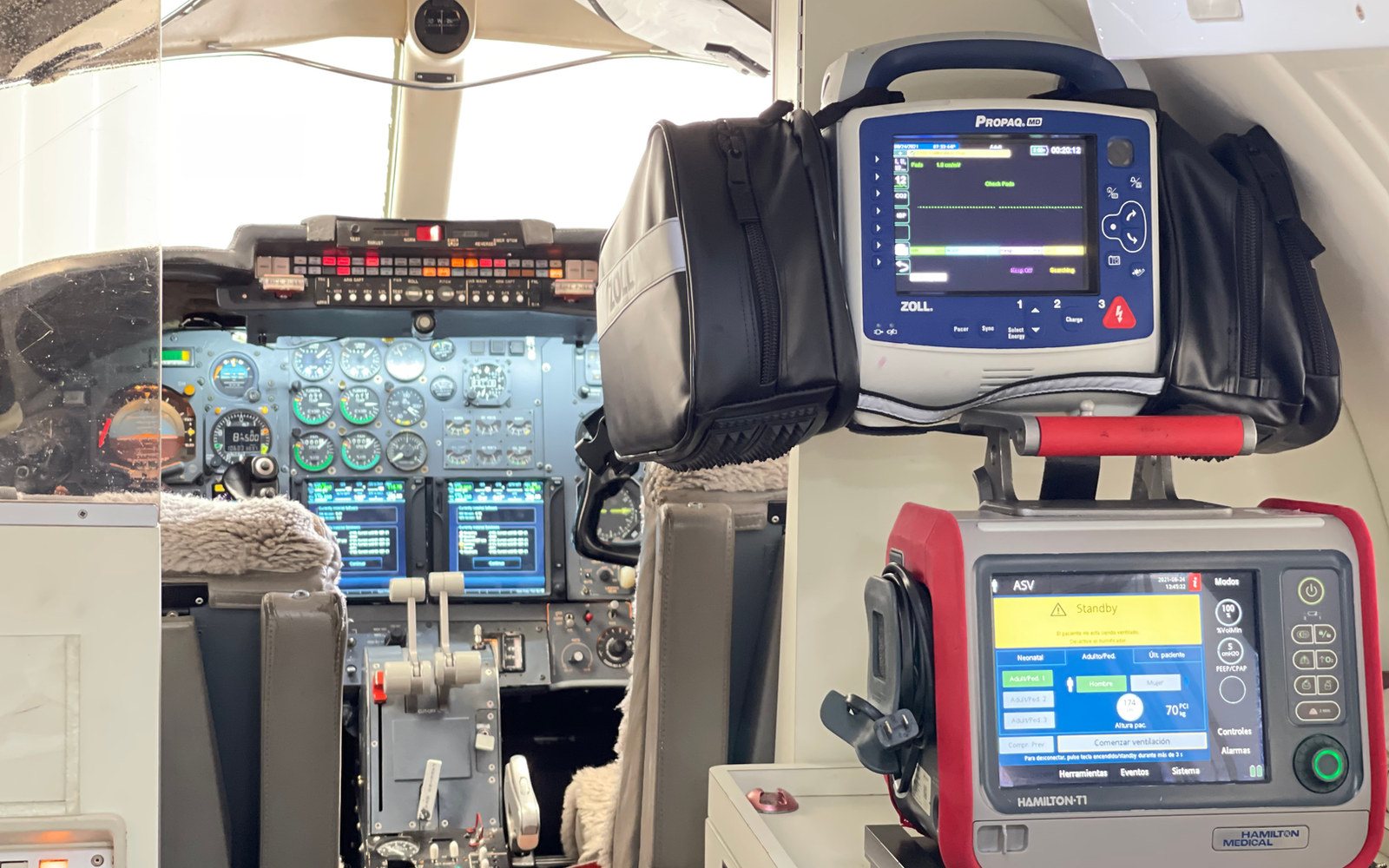
The aircraft itself must accommodate the care plan. That includes a secured stretcher system, transport ventilator, multiparameter monitor, suction, oxygen supply, infusion pumps, defibrillator, emergency medications, and sufficient electrical capacity and battery redundancy. For high-acuity cases, capability matters more than convenience.
Staff the mission for the expected risks
A neurocritical transfer should be staffed by clinicians with the training to manage airway emergencies, ventilation changes, hemodynamic instability, seizures, and medication infusions in transit. Depending on acuity, the team may include a critical care paramedic, paramedic, respiratory therapist, physician, or specialty clinician.
The team composition should reflect likely interventions, not merely minimum requirements. A ventilated patient receiving multiple vasoactive drips is different from an alert patient needing monitored transport after a completed procedure. When a patient’s condition is changing quickly, additional expertise can provide an important margin of safety.

Monitoring that continues beyond the ICU door
The patient should remain continuously monitored from bedside pickup to receiving-facility handoff. At minimum, this commonly includes cardiac rhythm, noninvasive or invasive blood pressure when indicated, oxygen saturation, respiratory rate, and temperature. Ventilated patients frequently require continuous capnography to help maintain the ventilation target prescribed by the clinical team.
Neurologic assessment does not stop during transport, even when sedation limits a full examination. Teams monitor pupil size and reactivity when feasible, motor response, sedation depth, seizure activity, and any change in vital signs that may signal worsening intracranial conditions. Documentation of baseline findings before departure gives the receiving team a meaningful point of comparison.
Equipment redundancy is not optional in this setting. Backup oxygen, power, monitoring leads, infusion capability, airway supplies, and medications must be available because replacement is not immediately accessible in flight. A capable transport provider plans for the equipment failure and the clinical event, not only the expected routine mission.
The details that prevent avoidable instability
Many transport complications begin with ordinary operational steps. Moving a patient from a hospital ventilator to a transport ventilator, transferring infusion pumps, repositioning the head, or navigating an elevator can create instability if performed without a structured process.
A disciplined pre-departure check should verify that all lines, drains, tubes, and monitoring cables are secured and visible. If the patient has an external ventricular drain, the transport plan must identify who is responsible for leveling, clamping or draining according to physician direction, and monitoring for complications. The device cannot be treated as a piece of luggage during loading.
Airway security also deserves special attention. Tube position should be confirmed, securing devices inspected, and contingency equipment positioned for immediate access. Patients with facial trauma, cervical spine concerns, obesity, or difficult airway history may need an especially deliberate plan. Once an aircraft is underway, the environment is less forgiving than a resuscitation bay.
Communication should remain direct and closed-loop. The sending team communicates current clinical priorities. The transport crew repeats back essential orders and confirms responsibility for medication, device, and ventilation management. The receiving team receives an updated estimated arrival time and advance notice of any deterioration. This level of coordination is particularly important for cross-border or long-distance transfers, where customs arrangements, ground ambulances, and destination acceptance must be synchronized with the medical timeline.

Questions families and referring teams should ask
When arranging a neurocritical transfer, ask whether the provider can support the patient’s actual therapies during transport, including ventilation, invasive monitoring, medication infusions, and specialized drains or devices. Ask who will be on the medical team, what backup equipment is carried, and how the crew communicates with the receiving facility.
It is also appropriate to ask how the provider coordinates bedside-to-bedside care. The air segment is only one part of the mission. Ground ambulance timing, airport access, clinical handoff, and destination readiness can determine whether the transfer protects or disrupts continuity of care.
For international transports, confirm that the operator can coordinate medical documentation, destination acceptance, aviation permissions, and ground logistics. These details can be complex, but they should be handled before the patient is exposed to unnecessary delays.
When rapid coordination matters
Some neurologic transfers are scheduled. Others cannot wait for a routine discharge process. A patient may need urgent access to neurosurgery, neurointerventional treatment, continuous EEG monitoring, a specialized stroke center, or a higher level of critical care.
Jet Rescue Air coordinates high-acuity medical transport missions with critical care planning, advanced onboard equipment, and rapid-response logistics for domestic and international cases. For a time-sensitive neurocritical transfer, early coordination allows the medical and aviation teams to identify risks, confirm the appropriate transport configuration, and prepare for safe departure.
The right transfer does more than move a patient to another facility. It preserves the care plan during the most vulnerable part of the journey, so the receiving team can continue treatment without losing ground.
Tell us about the patient
A mission coordinator answers 24 hours a day. The benefits review is free and carries no obligation.