


Infectious disease air ambulance transport
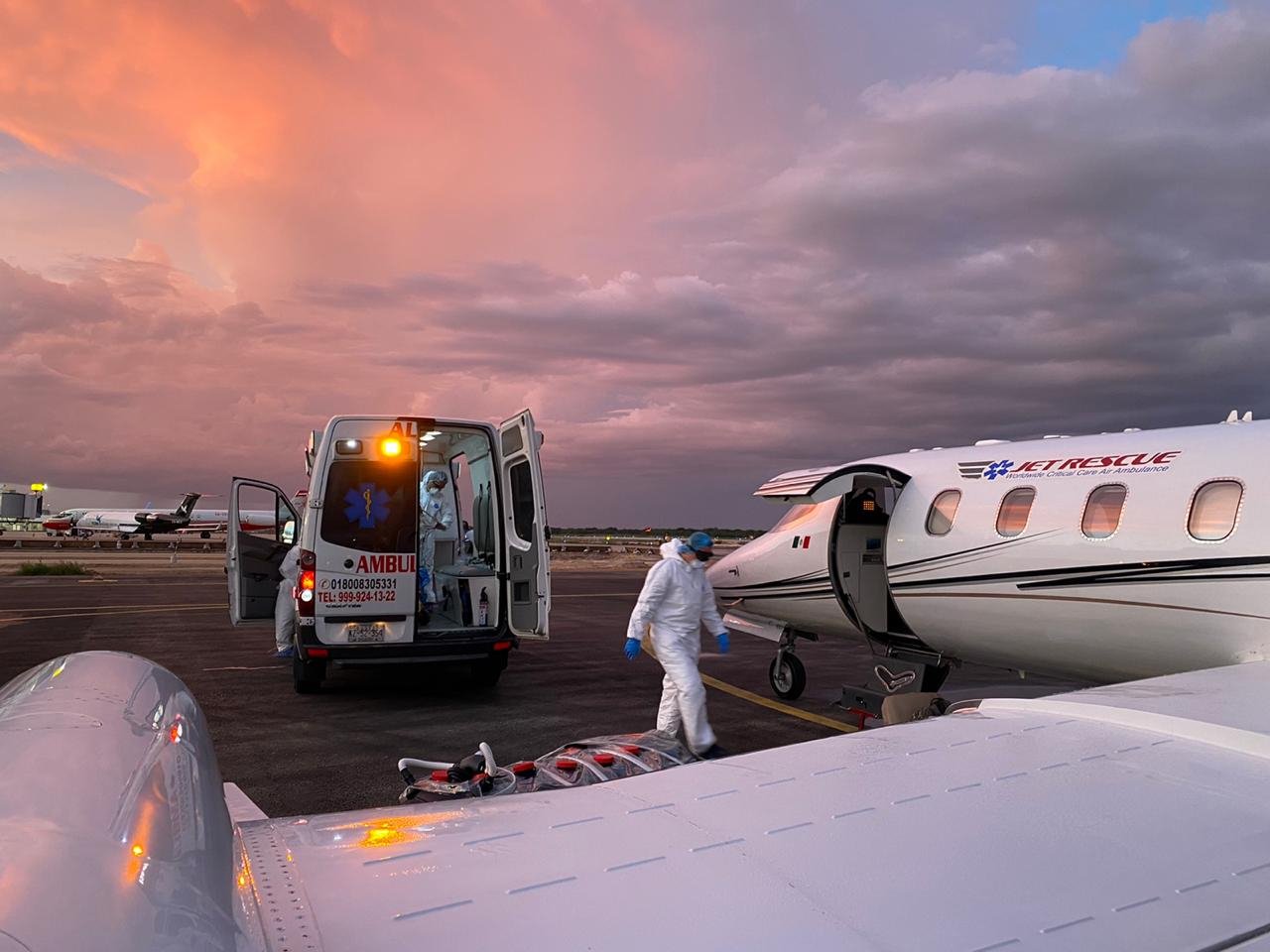
Patient transport under full isolation in a sealed negative pressure chamber, with crews trained and equipped for the handover at both ends.
Moving a patient who is contagious
An infectious patient is not simply a patient who needs a flight. Everyone who touches the case — the referring ward, the ground crews at both ends, the flight crew, the receiving hospital, the other people in two airports — has to be kept out of the transmission path, and the patient still has to arrive in better shape than they left.
Jet Rescue flies these cases under full isolation, using a sealed negative pressure chamber on the stretcher platform. Negative pressure means the air inside the chamber is held at a slightly lower pressure than the cabin around it, so air flows in through the filters rather than out into the aircraft. The patient is inside it. The crew works through sealed ports. Nothing the patient exhales reaches the cabin unfiltered.
Aruba to Los Angeles, 19 March 2020
On Thursday 19 March 2020, a Jet Rescue aircraft landed at Los Angeles International Airport just before 11 a.m. carrying a 65-year-old man from Orange County who had tested positive for COVID-19 while in Aruba. He was carried in a negative pressure isolation chamber. The cabin was lined in plastic. On board were two pilots, a doctor and a paramedic, in full biohazard protective equipment.
The aircraft was met near a private terminal by U.S. Customs and Border Protection and a ground ambulance, and the patient was transferred to St. Joseph's Hospital in Orange, California.
Jet Rescue was the first civil air ambulance company to carry a COVID-19 patient. Writing two weeks later, the industry title AirMed&Rescue described Jet Rescue as “the first North American air ambulance to offer transport of Covid-19 patients”.
The date matters. In mid-March 2020 there was no settled protocol for any of this. Borders were closing by the day, commercial aviation was shutting down, and the guidance on how the virus actually moved between people was changing week to week. The flight was covered at the time by CBS Los Angeles, FOX 11 Los Angeles, KTLA and ABC7.
We bought the capability three years before we needed it
The reason that call could be answered in days rather than months is that the equipment and the training were already in the building. AirMed&Rescue noted at the time that Jet Rescue had been one of the first air ambulance operators to acquire isolation transport capability — three years before the pandemic, in 2017, when there was no obvious commercial reason to own it.
That is the whole argument for this kind of investment. Isolation capability is worth nothing in the years you do not use it and worth everything in the week you do. We have kept it current since.
What we fly now
COVID-19 is still with us, and we still move patients who have it. It is no longer the emergency it was in 2020, and it is no longer the only reason a case needs isolation. The same chamber, the same crews and the same procedures carry:
- Active or suspected tuberculosis, including multi-drug-resistant TB
- Measles, chickenpox and other airborne viral illness
- Meningococcal disease
- Viral haemorrhagic fevers and other high-consequence infectious disease
- Multi-drug-resistant organisms — MRSA, CRE, C. difficile and the rest — where the receiving unit needs the patient to arrive already contained
- COVID-19, influenza and other respiratory viral infection in a patient sick enough to need an air ambulance
- Suspected cases where the diagnosis has not come back yet and nobody can afford to assume it is negative
What the transport actually involves
Before the flight
We confirm the diagnosis or the suspicion with the referring team, the isolation precautions in force, and the ventilation and oxygen requirements. We agree the handover points at both ends — where the ground ambulance meets the aircraft, who is on the ramp, which door the patient goes through at the receiving hospital. For an international case we clear the arrival with the relevant authorities in advance, so the aircraft is expected rather than discovered.
In the air
The patient is in the chamber. The crew is in protective equipment for the duration, which is harder than it sounds on a long leg — it is hot, it restricts your hands and your field of view, and you cannot take it off to eat or drink. Monitoring, ventilation, infusions and suction all run through the chamber. A ventilated patient flies with viral filters on the circuit.
After the flight
The chamber and the cabin are decontaminated before the aircraft flies again. Protective equipment is disposed of as clinical waste. The crew follows the exposure protocol that applies to the organism involved. None of this is billed as an extra and none of it is skipped.
What to tell us when you call
- The organism, if it is known, or what is suspected and when the result is due
- Whether the patient is ventilated, and on what settings
- The isolation precautions currently in force on the ward
- Where the patient is now and where they need to be
- Whether the receiving hospital has accepted the patient
If you are not sure whether a case can be flown, call anyway. We will tell you straight away whether we can take it, and if we cannot, we will say so rather than leave you waiting.
Tell us about the patient
A mission coordinator answers 24 hours a day. The benefits review is free and carries no obligation.