Jet Rescue Donates Life-Saving Air Ambulance Flight From Mexico to Texas

Updated: Feb 12
Critically Burned Victim is transported by Jet Rescue Free of Charge to Galveston Texas.
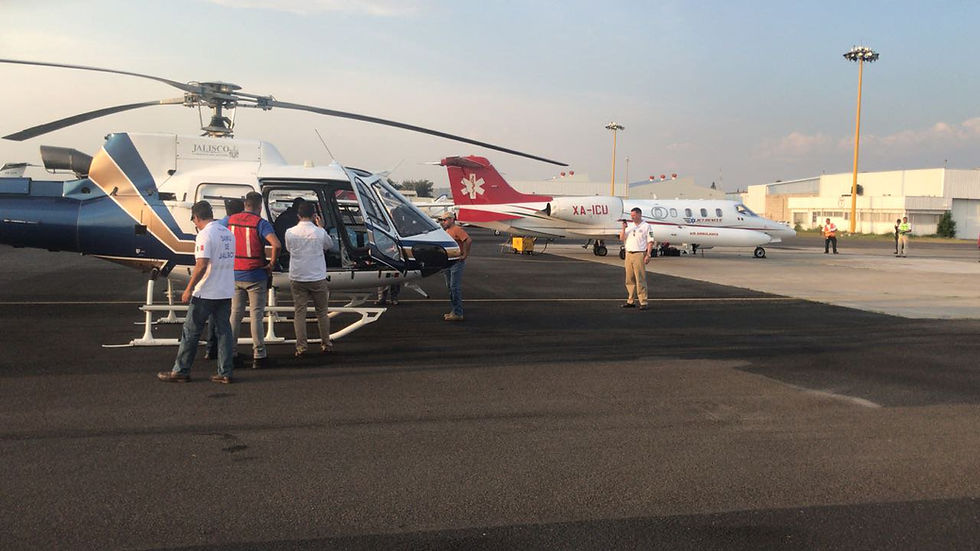
A critically burned patient in Mexico was urgently transported to a specialized burn center in Galveston, Texas after Jet Rescue Air Ambulance donated a fully equipped international air ambulance flight at no cost to the family.
The mission highlights how medical air transport organizations can rapidly move patients across borders when local hospitals cannot provide the level of care required for survival.
What Happened
When a severe burn injury occurs, the first 24–72 hours are often the difference between life and death. The patient required treatment at a major burn center capable of advanced wound management, infection control, and reconstructive care.
Because the necessary resources were not available locally, the patient needed immediate international evacuation.
Jet Rescue coordinated the transfer from Mexico to the University of Texas Medical Branch Burn Center in Galveston, Texas — one of the most advanced burn treatment facilities in North America.
Key facts:
• Patient suffered critical burn injuries requiring specialized care
• Local hospitals were unable to provide definitive treatment
• A cross-border medical evacuation was necessary• Jet Rescue provided the flight free of charge
• Transport was performed in a fully staffed ICU air ambulance aircraft
Why Burn Victims Need Specialized Burn Centers
Severe burns are not treated like normal trauma cases. Patients often need weeks or months of intensive care.
Specialized burn units provide:
• Infection-controlled environments (burn patients are extremely vulnerable)• Skin grafting and reconstructive surgery
• Respiratory support for smoke inhalation injuries
• Pain management and sedation
• Long-term rehabilitation and mobility therapy
Many hospitals simply do not have these capabilities, which is why international air ambulance transfers are often required.
How an Air Ambulance Works
An air ambulance is essentially a flying intensive care unit (ICU). The aircraft used by Jet Rescue is equipped to provide continuous treatment while in flight.
Typical onboard equipment:
• Mechanical ventilators
• Cardiac monitors and defibrillators
• IV infusion pumps and medications
• Advanced airway equipment
• Critical care transport stretchers
Medical team onboard:
• Critical care physician
• Flight nurse
• Paramedic
The patient receives uninterrupted treatment from hospital bed to hospital bed.
Why This Flight Was Donated
International air ambulance flights are expensive. Cross-border ICU transfers can cost tens of thousands of dollars depending on distance, equipment, and staffing.
In this case, Jet Rescue elected to donate the mission as a humanitarian response.
The goal was simple: remove financial barriers so the patient could receive life-saving treatment immediately rather than waiting for insurance approvals or funding.
The Importance of Rapid Medical Transport
Time matters with burn injuries.
Complications can escalate quickly:
• Sepsis (infection entering the bloodstream)
• Organ failure
• Airway swelling from inhalation burns
• Severe dehydration and shock
Rapid transfer to a burn center significantly improves survival and recovery outcomes.
Air ambulance transport makes that possible when ground transport would take too long or crossing international borders complicates emergency care.
International Medical Evacuations: What Families Should Know
Families often do not realize medical transport across countries is possible until a crisis occurs.
Important facts:
• Air ambulances can coordinate international hospital admissions
• Medical teams manage customs and immigration clearances
• Patients can travel while sedated or ventilated
• The receiving hospital is prepared before arrival
In critical cases, the transport team also communicates directly with physicians at both hospitals to ensure continuity of care.
Why Galveston, Texas
The Galveston burn center was selected because it provides advanced burn reconstruction and long-term recovery care. Facilities like this treat some of the most complex burn cases in the Western Hemisphere.
For patients with life-threatening burns, access to the right facility — not just the nearest facility — is often what saves their life.
Frequently Asked Questions
How fast can an air ambulance be arranged?
In emergency situations, flights can often be organized within hours once the receiving hospital accepts the patient.
Can patients travel while on a ventilator?
Yes. ICU-level air ambulances are specifically designed for ventilated and sedated patients.
Do air ambulances cross international borders?
Yes. Companies coordinate permits, customs clearance, and hospital admission.
Are these flights covered by insurance?
Sometimes. Coverage depends on the policy and medical necessity documentation.
Can families travel with the patient?
In many cases, one relative can accompany the patient depending on aircraft configuration and medical condition.
What This Mission Demonstrate
This transport shows the real purpose of emergency medical aviation: getting a patient to the right care, not just the closest care.
By donating the flight, Jet Rescue removed delays that could have cost the patient their life. In severe trauma and burn cases, rapid access to specialized treatment is often the single most important factor in survival and recovery.
Life-saving care sometimes depends not on geography, but on speed — and the ability to bring the hospital to the patient and the patient to the hospital.